
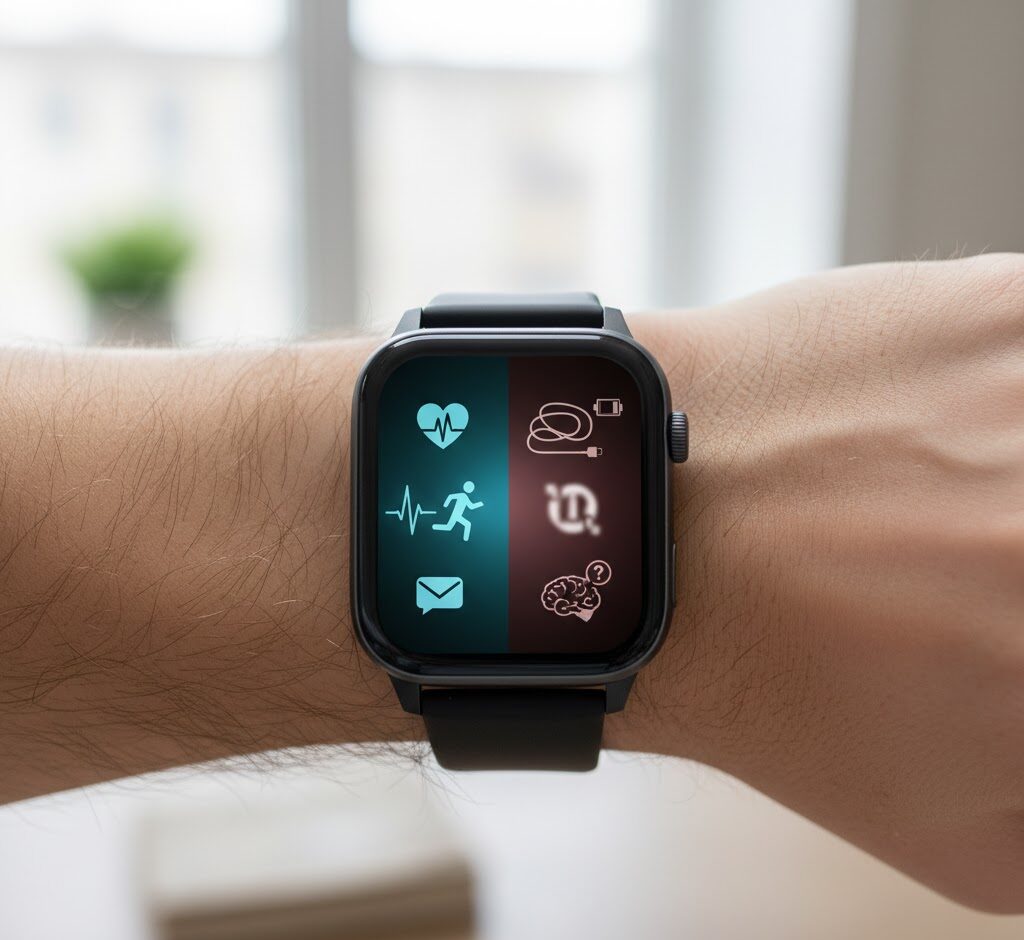
A decade ago, a watch just told time. Today, it can monitor your heart’s rhythm, track your sleep quality, and call for help if you fall. But with all this power comes new questions. Are these devices truly accurate? Are they creating more anxiety than they solve? And are they worth the high price tag?
If you’re wondering about the real pros and cons of smart watches, you’re not alone. It’s a major purchase with real implications for your health and daily life. Unlike other guides, we will go beyond the obvious (like notifications) and dive deep into the critical health aspects, including data accuracy, privacy risks, and the psychological impact of 24/7 monitoring.
This guide provides a balanced, expert-backed analysis to help you decide if a smartwatch is the right choice for you.
Table of Contents
Key Takeaways
- Top Pros: The primary benefits are advanced health monitoring (ECG, SpO2, sleep tracking), enhanced fitness motivation, and critical safety features like fall detection and Emergency SOS.
- Top Cons: The main drawbacks include the potential for data inaccuracy, the risk of “health anxiety” from constant monitoring, significant privacy concerns, and practical issues like poor battery life and high cost.
- Health Anxiety: Over-monitoring can lead to stress. A study published in the Journal of Medical Internet Research found that while many users feel empowered, others experience increased anxiety from ambiguous health data.
- Not a Medical Device: Smartwatches are powerful wellness tools, but they are not a substitute for medical-grade equipment or a doctor’s diagnosis.
The “Pros”: Key Health & Lifestyle Benefits of Smartwatches
Modern smartwatches offer powerful benefits that integrate directly into your life.
Pro 1: Advanced Health & Fitness Monitoring
This is the number one reason most people buy a smartwatch. Modern devices act as a health dashboard on your wrist.
- Heart Health: Many models are cleared by the FDA to take an electrocardiogram (ECG) and can notify you of potential signs of atrial fibrillation (Afib). They also monitor your resting and active heart rate.
- Blood Oxygen (SpO2): This feature can help you understand your respiratory health and how well you acclimatize to altitude, or identify potential issues like sleep apnea.
- Sleep Tracking: Watches can now track your sleep stages (Light, Deep, REM) and provide a “sleep score,” helping you build better habits.
- Fitness Motivation: “Closing your rings” or hitting step goals provides a powerful, gamified motivator to stay active.
Pro 2: Immediate Access to Notifications
Seeing texts, calls, and app alerts on your wrist allows you to stay connected without pulling out your phone. This is a massive convenience, whether you’re in a meeting, driving, or working out.
Pro 3: Safety and Emergency Features
For many users, especially seniors or those who live alone, this is the most important feature.
- Fall Detection: The watch can detect a hard fall and automatically call emergency services and your emergency contacts if you don’t respond.
- Emergency SOS: You can press and hold a button to quickly contact local emergency services and share your location.
- Crash Detection: Newer models can detect if you’ve been in a severe car crash and alert authorities.
Pro 4: Convenience for Navigation and Payments
Getting turn-by-turn directions that “tap” you on the wrist or paying for groceries with your watch (NFC payments) are small conveniences that add up, allowing you to leave your phone in your pocket.
The “Cons”: Critical Risks & Drawbacks to Consider
Before you buy, it’s essential to understand the potential downsides, which are often overlooked.
Con 1: Health Data Accuracy & “Health Anxiety”
While advanced, these sensors are not perfect. A 2022 study on wearable heart rate sensors found that accuracy can decrease significantly with darker skin tones and during vigorous exercise.
This can lead to two problems:
- False Negatives: The watch misses a real problem, giving you a false sense of security.
- False Positives: The watch flags a potential issue (like Afib) that isn’t there, causing unnecessary panic and expensive trips to the doctor.
User Experience: “I had to stop wearing mine. I became obsessed with my sleep score and heart rate variability. Every time my ‘readiness’ score dipped, I’d panic, thinking I was sick. It was causing more stress than it was solving.”
Con 2: Constant Distractions and Psychological Impact
A “pro” (notifications) can quickly become a “con.” The constant buzzes and pings can fragment your attention, disrupt your focus, and make it difficult to be present. This “always-on” culture can contribute to burnout and anxiety.
Con 3: Data Privacy and Security Vulnerabilities
Your smartwatch collects an enormous amount of your most sensitive information: your location, your heart rate, your sleep patterns, and even your blood oxygen levels.
Where does this data go? Who has access to it? While companies have privacy policies, breaches happen. You must be comfortable with a tech company holding and analyzing your personal health data.
Con 4: Battery Life, Cost, and Obsolescence
- Battery: Most feature-rich smartwatches require charging every day. If you forget, it becomes a useless bracelet.
- Cost: Premium models are expensive, often costing as much as a new smartphone.
- Obsolescence: Like phones, smartwatches are often replaced every 2-3 years as batteries degrade and new features are released. A traditional watch can last a lifetime.
Addressing a Common Fear: What About Radiation (EMF)?
Many users worry if wearing a tiny computer 24/7 is safe. Smartwatches emit low levels of non-ionizing radiation (EMF) to communicate via Bluetooth, Wi-Fi, and cellular.
According to major health organizations, including the World Health Organization (WHO) and the U.S. National Cancer Institute, this type of low-energy, non-ionizing radiation has not been found to cause harmful health effects or cancer in humans. The levels emitted are far below established safety limits.
Final Verdict: Who Should (and Shouldn’t) Get a Smartwatch?
So, is a smartwatch worth it? It depends entirely on your goals and personality.
A Smartwatch is Likely Worth It If…
- You want a powerful tool to motivate your fitness journey.
- You have a specific health condition (like Afib) and your doctor supports using one for monitoring.
- You value the safety features like fall detection for yourself or a loved one.
- You love technology and the convenience of notifications and mobile payments.
You Might Want to Reconsider If…
- You have a history of health anxiety or obsessive-compulsive tendencies.
- You are easily distracted and are trying to reduce your screen time.
- You are highly concerned about your personal data privacy.
- You hate the idea of charging another device every single night.
[Read our guide to understanding {how to choose the best smartwatch for your health goals}]Frequently Asked Questions
What are the main disadvantages of wearing a smartwatch?
The biggest disadvantages are the limited battery life (often requiring daily charging), the high cost, and the constant digital distractions. From a health perspective, the data can be inaccurate and may lead to “health anxiety,” where a user becomes stressed or obsessed with their health metrics.
Is it worth it to buy a smartwatch in 2025?
For many, yes. If you will actively use the health, fitness, and safety features, it is a valuable tool. If you only want it to tell time and see notifications, a simpler, cheaper fitness tracker (or a traditional watch) may be a better value.
Do smartwatches cause any health problems?
There is no scientific evidence that smartwatches cause health problems like cancer from radiation (EMF). The primary “health problem” they can cause is psychological: the data can induce anxiety, stress, or obsessive behavior in some individuals.
What is the main purpose of a smartwatch?
The main purpose has evolved. It is now a comprehensive health and wellness device that also serves as a companion to your smartphone, providing notifications, navigation, and quick access to information on your wrist.
When to See a Doctor About Your Health Data
This is the most important takeaway. Your smartwatch is not a doctor.
Treat your watch data as an “check engine light”—it can suggest a problem, but it cannot diagnose one.
Always see a doctor if you:
- Experience real symptoms like chest pain, shortness of breath, dizziness, or heart palpitations, regardless of what your watch says.
- Receive a concerning health notification from your watch (like a high heart rate alert or an Afib warning). Use this as a reason to start a conversation with your doctor, not as a reason to panic.
- Feel that monitoring your health data is causing you significant stress or anxiety.
[Read our guide to understanding {how to talk to your doctor about wearable data}]Ultimately, a smartwatch is a tool. The pros are high-tech and convenient, while the cons are practical and psychological. By understanding this balance, you can make an informed choice that truly benefits your health and well-being.
Disclaimer: This article is for informational purposes only and does not constitute medical advice. The information contained herein is not a substitute for, and should never be relied upon for, professional medical advice. Always talk to your doctor about the risks and benefits of any treatment.
Published on November 7, 2025 and Last Updated on November 7, 2025 by: Priyank Pandey
Get real time update about this post category directly on your device, subscribe now.

